
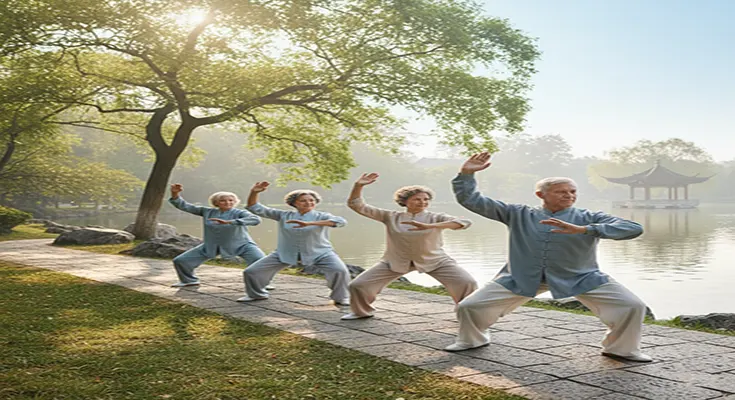
Falling is a leading cause of injury and disability among older adults. As balance naturally declines with age, preventing falls becomes a critical focus for maintaining independence and quality of life. Emerging as a powerful, non-pharmacological intervention is Tai Chi, an ancient Chinese martial art practiced as a sequence of slow, continuous, and graceful movements. For older adults, the practice offers substantial and well-documented benefits for balance improvement that directly contribute to fall prevention.
The Science of Stable Motion ⚖️
Tai Chi, often described as “meditation in motion,” works on multiple physiological systems critical for balance and stability.
- Proprioception Enhancement: Tai Chi involves continuous, subtle shifts of weight from one leg to the other, moving through the center of gravity. This constant, conscious attention to body position—known as proprioception—trains the brain to accurately recognize where the limbs and torso are in space. Research consistently shows that Tai Chi improves the sensitivity of the peripheral nervous system, which is essential for correcting small stumbles before they become falls.
- Muscular Strength and Endurance: Although the movements are gentle, holding the deep, squat-like postures (even slight ones) builds core and leg muscle strength, particularly in the ankles and hips. Stronger leg muscles provide the power needed to initiate recovery steps and better stabilize the joints during unexpected perturbations.
- Improved Flexibility and Joint Mobility: The large, circular movements gently stretch muscles and connective tissue. Improved ankle and hip flexibility increases the range of motion, allowing the body to absorb impact and adjust posture more effectively when encountering uneven surfaces.
Direct Impact on Fall Prevention 🛡️
Multiple meta-analyses and randomized controlled trials (RCTs) confirm the efficacy of Tai Chi specifically for fall risk reduction in the 65+ demographic.
- Widening the Base of Support: The slow practice encourages practitioners to adopt a wider, lower stance than they might naturally use when walking. This wider stance provides a larger, more stable base of support, making it harder to tip over.
- Cognitive Dual-Tasking: Tai Chi requires simultaneous focus on breathing, movement sequence, and maintaining posture. This is a form of cognitive dual-task training, which mimics real-life situations—like walking while talking or carrying groceries. By training the brain to manage multiple demands without sacrificing balance, practitioners are better equipped to avoid falls during distracted moments.
- Reduced Fear of Falling: Beyond physical improvements, Tai Chi builds self-efficacy. As older adults gain confidence in their stability and movement, their fear of falling decreases. This is a significant benefit, as a high fear of falling can lead to reduced activity, which paradoxically leads to muscle atrophy and a higher actual fall risk.
Tai Chi is unique because it combines aerobic exercise, strength training, and mindfulness into one holistic practice. Its low-impact nature makes it accessible to individuals with chronic conditions or limited mobility, cementing its status as one of the most effective and gentle methods for older adults to improve balance and ensure a safer, more active lifestyle.